Архив рубрики: AI

The AI-Native Stack: From Structured Specs to Verified Code

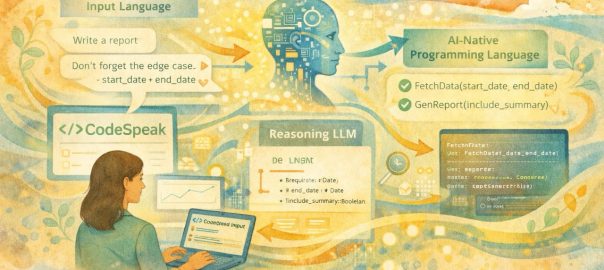
A week ago, I suggested the need for a new programming language tailored for AI output to tackle the human verification bottleneck. The discussion that followed was lively, and this subject remains an intriguing one.

We discussed the language the model uses to produce its output. However, there’s another important aspect: the language used for writing input specifications. This is even more critical because the quality of the output depends directly on the quality of the input (see my post from last weekend).

Читать далее The AI-Native Stack: From Structured Specs to Verified Code

The AI-Native Language: Solving the Human Bottleneck

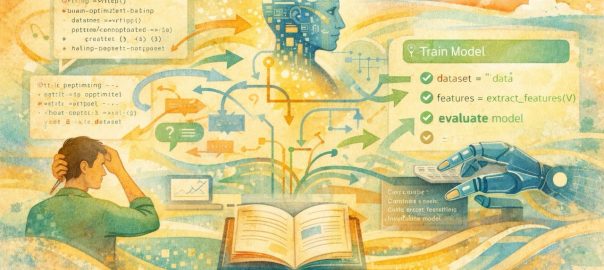
The more I work with AI, the more I realize that we, the humans, have become the bottleneck in the code production process. We participate in the loop at least at two critical points: defining the task and checking the results. These two points are now the main areas where we need to optimize how humans and AI talk to each other. In both cases, the languages we use aren’t really fit for the job. On the input side, we use human languages like English to prompt the model. On the output side, the model gives us code in languages originally designed for humans to write by hand. I believe this is exactly where we’ll see new solutions very soon.

Читать далее The AI-Native Language: Solving the Human Bottleneck

Language: The Bridge Between Human Evolution and Artificial Intelligence

Preface

This post originated from my own thoughts and knowledge, which I shared with and had challenged by AI. This text represents a deeper analysis of those initial ideas, enriched by supporting materials from books and white papers found during our dialogue, and refined through a process of challenging assumptions and removing bias. I use this collaborative approach to educate myself, and I found the resulting synthesis valuable enough to share.

Introduction

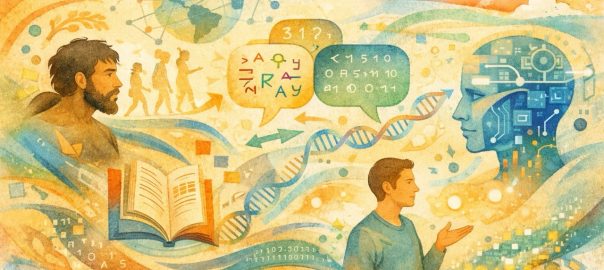
When we look back at human history—not just recent history, but the million years of early human development—something shifts dramatically around 70,000 to 100,000 years ago. As Yuval Noah Harari describes in Sapiens, the evolutionary development before that point was, in relative terms, glacially slow. Humans looked much like other primates, with similar cognitive constraints and limitations. Then something changed: language—or rather, language as a complex system of symbolic communication—arrived, and with it, the ability to think in long sequences of meaningful symbolic units.

This is not merely about communication. It is about the fundamental shift in how humans could think. Before language matured as a tool for complex thought, human cognition likely operated through images, sounds, and visual signals. Language opened the door to something categorically different: the ability to reason in abstract sequences, to imagine absent things, to discuss concepts that do not exist in the immediate environment. This capacity unlocked civilization.

And this is why I believe—not as speculation, but as a reasonable extrapolation from history—that building artificial systems capable of working with language is not hype. It is a continuation of the same lever that once transformed human civilization.

Читать далее Language: The Bridge Between Human Evolution and Artificial Intelligence

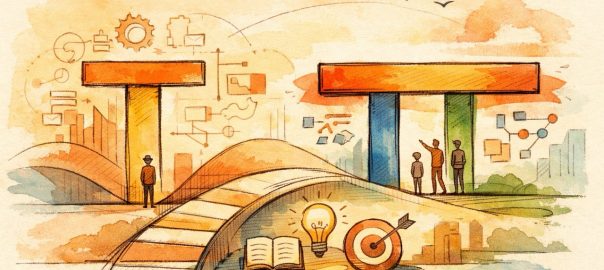
T-shaped 2.0: how the depth of an engineer changes in the AI era

For many years, we were told: “Become a T-shaped specialist: broad knowledge and real depth in one area — frontend, backend, mobile, AI, and so on.”

This model is still alive, but its meaning is clearly changing under the pressure of AI and automation.

Читать далее T-shaped 2.0: how the depth of an engineer changes in the AI era