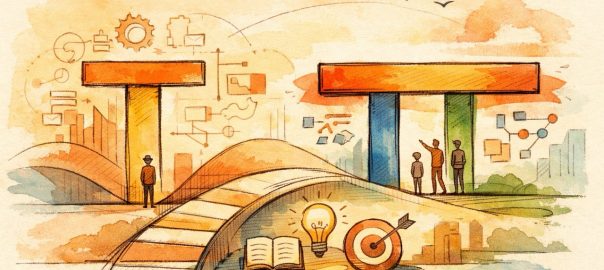
For many years, we were told: “Become a T-shaped specialist: broad knowledge and real depth in one area — frontend, backend, mobile, AI, and so on.”
This model is still alive, but its meaning is clearly changing under the pressure of AI and automation.
Before, the vertical line of the “T” usually meant: “I deeply know technology X — this framework, this stack, this language.” Today, this is becoming a fragile strategy. Tools based on generative AI can already handle a large part of routine technical work: writing standard CRUD code, building forms, preparing boilerplate code, and generating tests.
Video overview
If you’d rather check out the video or audio version of this material, take a look at the video on YouTube.
Where depth is moving
Depth is no longer about a specific programming language and framework. It is becoming about a specific class of problems and systems.
- Not a “React developer”, but an engineer of complex interfaces: accessibility, performance, design systems, UX consistency.
- Not just a “Spring backend developer”, but an engineer of high-load and reliable systems: transactions, consistency, queues, fault tolerance, and monitoring.
- Not “a person who connects the GPT API”, but an AI product engineer: model choice, data quality, evaluation, security, AI-related UX.
This kind of depth is much harder to automate because it depends on system thinking, experience, and the ability to work with risk, not just on the ability to “write code correctly”.
The horizontal bar of the T becomes thicker
There is an interesting paradox: the more AI removes routine work, the higher the demand for breadth. Breadth is no longer just “I know a bit of frontend and a bit of backend.”
The modern horizontal bar includes:
- Understanding the main layers of a system — from client to database and infrastructure; basic literacy in cloud platforms, CI/CD, containers;
- Product thinking: how a feature affects metrics and business, where real value is.
- The ability to work with AI assistants as real tools, not as “magic autocomplete”.
The market increasingly looks for people who can speak the same language with several neighboring roles at once — product, design, analytics, DevOps, security.
Such people become the connective tissue of teams.
What is expected from us now
If you look at job descriptions and role discussions, a new set of expectations appears.
An engineer is expected to:
- Understand the fundamentals broadly enough to navigate architecture, not only their own module.
- Have 1–2 areas of real depth (types of problems, not a single tool).
- Use AI effectively to speed up work, without losing control over solution quality.
- Be able to relearn and redefine their “vertical” every few years, as technologies and domains change.
In essence, the T-shaped model evolves into “T-shaped plus”: a thick horizontal bar + one or two deep verticals in problem domains, not in specific frameworks.
What an engineer should prepare for
If we translate all this into a practical plan, it looks like this.
1. Thicken the horizontal bar:
- Learn basic full-stack skills: at least be able to read and edit code in neighboring layers.
- Understand the basics of cloud, CI/CD, monitoring, logging, and perimeter security.
- Improve product thinking: how to measure value, read metrics, and talk to customers and product managers.
2. Choose 1–2 problem areas for depth:
- Examples: “reliable distributed systems”, “complex interfaces and design systems”, “AI products”, “platform engineering and DevEx”, “security and compliance”, and so on.
- Study not only tools, but principles: patterns, architectures, common failures, traps, and limits.
3. Learn to work with AI as a normal tool:
- Learn to formulate tasks and verify results, not just “copy answers”.
- Use AI for research, prototyping, refactoring, tests, and documentation.
- Gradually build your own toolkit of assistants and automations around you.
4. Build a habit of changing your vertical:
- Treat your current specialization not as a final identity, but as a temporary focus for the next 3–5 years.
- Plan which neighboring domains you could move into with minimal friction.
Conclusion
The T-shaped specialist is not disappearing, but the emphasis is changing.
Instead of narrow technical depth on top of a modest base, we now need a wide and strong foundation, on top of which one or two deep specializations by problem type are built.
AI does not cancel this model — it makes it more demanding.
The winner is not the one who “writes the best code in X”, but the one who understands systems better and knows how to learn.